

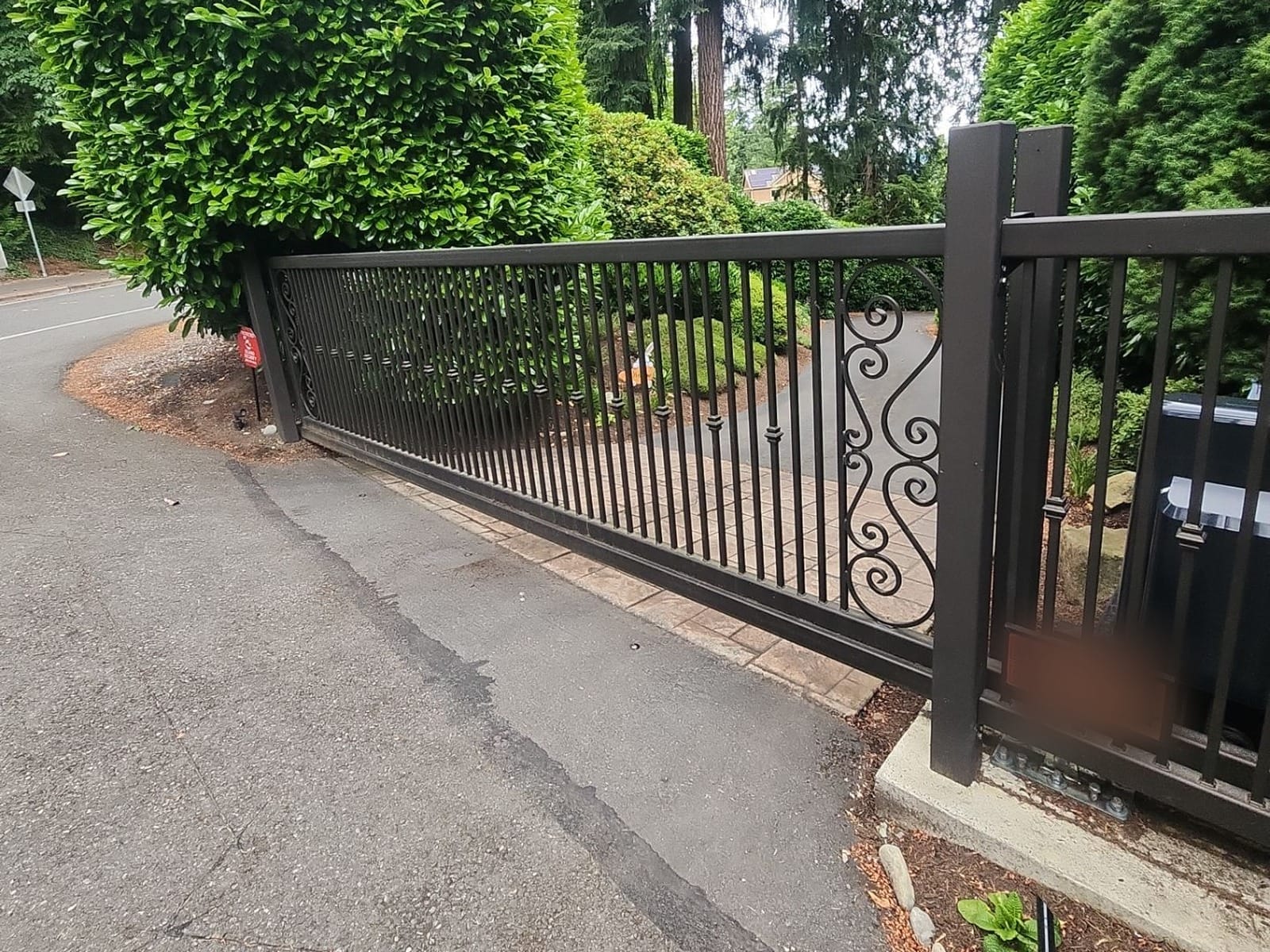
Our last post was about a gate that refuses to close. This one is about the opposite, and it is the one that actually worries us.
A gate that will not close announces itself. You notice it the first evening. You call somebody.
A gate that closes every single time, on schedule, without complaint, tells you nothing at all. It can be doing that for years while the systems meant to stop it from closing on something have quietly stopped working. Nothing on the property looks wrong, because nothing looks like anything. The gate just works.
What the standard is actually for
Automated gates in the United States are built to a safety standard called UL 325. Most gate owners have never heard of it, which is fine, because it is not really written for them. It is written for the people who build and install the equipment.
What is worth knowing is the problem it exists to solve.
A powered gate is a heavy object that moves on its own, on a schedule nobody standing nearby is aware of. The standard is concerned with what it calls entrapment: the places where a person, a pet, or a vehicle can end up caught between the gate and something else. The leading edge as it closes. The gap between the gate and a post. On a slide gate, the space behind it as it retracts, which is the one nobody thinks about because the gate is moving away from you.
The requirement is not that the gate be gentle. It is that the gate be able to tell something is there, and stop.
That means an automated gate is supposed to carry more than one independent way of detecting an obstruction. Typically that is the operator sensing resistance and reversing, plus at least one external device watching the opening: photo eyes across the gap, a sensing edge along the leading edge, or both. More than one, on purpose, because any single device can fail.
Why gates drift out of compliance
Almost nobody sets out to run an unsafe gate. It happens by accumulation.
- The standard moved. UL 325 has been revised several times, and the requirements for entrapment protection got meaningfully stricter along the way. A gate installed to the rules of its era can be fully legitimate and still be well behind what a gate installed today has to carry.
- A device failed and was never replaced. A photo eye takes a knock from a delivery truck, stops working, and the gate keeps running. Nothing stops. Nothing warns anyone.
- Somebody bypassed it. A sensor fault made the gate refuse to close, and instead of a service call the device got unplugged or jumpered so the gate would behave. This is the one we find most often on properties that have changed hands, and the current owner almost never knows.
- The gate was modified. A new operator, a longer leaf, an added keypad, a rebuilt post. Each change is small. The protection that was correct for the original configuration may not cover the new one.
- It was never right. Not every gate on the ground was installed by someone who treated the standard as a requirement rather than a suggestion.
None of these produce a symptom. That is the whole point of this post.
The insurance question, asked honestly
There is a lot of content in our industry telling property owners that their insurer requires UL 325 compliance and that a non-compliant gate voids coverage.
We are not going to tell you that, because we are a gate company and not your insurer, and the answer genuinely depends on your carrier and your policy.
What we will say is that it is a reasonable question to ask, and a cheap one. If you own a gate on a commercial property, a multi-family property, or an HOA, call your agent and ask two things: whether your policy has any expectation about automated gate safety equipment, and what documentation they would want to see after an incident. Whatever the answer is, you want it before something happens rather than after.
The liability side is simpler and does not depend on anyone’s policy. If an automated gate on your property closes on a child, the question that gets asked is whether the equipment that should have prevented it was present and working. That is a question with a factual answer, and the answer gets established after the fact, by someone else.
How to tell where your gate stands
Some of this you can see from the driveway.
- Look for the eyes. Small sensors mounted low on both sides of the opening, pointing at each other. If there is nothing there, the gate is relying on the operator alone to detect an obstruction.
- Look at the leading edge. Some gates carry a sensing edge, a rubber strip along the closing edge that triggers on contact. Not every gate needs one, but between it and photo eyes, a gate should have something.
- Check whether anything is disconnected. A sensor hanging off its bracket, a cut wire, a lens taped over, a device that is clearly present but obviously not in service.
- Watch a full close cycle from a safe distance, standing well clear of the gate’s path. Note whether it slows near the end and whether it behaves the same way every time.
Trinity Gate publishes a Gate Safety Self-Check on our preventive maintenance page, eight checks you can run yourself and keep a record of. It is a good afternoon’s work and it costs nothing.
What it will not do is test the devices, and that matters. A photo eye that looks fine can be out of alignment by an amount your eye cannot see. Testing entrapment protection properly means checking that each device actually stops the gate, which is part of what a maintenance visit covers.
If yours is behind
The good news is that this is almost always a retrofit rather than a replacement.
Adding or upgrading entrapment protection on an existing gate is ordinary work. Modern photo eyes and sensing edges are available for essentially any operator we are likely to find on your property, and bringing an older gate up to current protection is a fraction of what the gate itself cost. In most cases it is a single visit.
The gates that need more than that are usually the ones where the operator itself predates the electronics, and in that case the conversation is a broader modernization one anyway.
Worth knowing before you need to know it
If you cannot say with confidence what would happen if something were in the way when your gate closed, that is worth an hour of somebody’s attention.
Call us at (425) 881-3554 and we will come look at what is actually on your gate and tell you plainly where it stands. We install, service, and retrofit automated gates and access control across the Puget Sound region, including Redmond and Issaquah and the rest of our service area.
A gate that works is not the same as a gate that is safe. Most of the time they are, and it is worth knowing which one you have.
